Radiator Cover Ideas at a Glance (2026 UK Prices)
The best radiator cover ideas in 2026 treat the cover as furniture, not a box: hallway covers with a bench or drawers, black slatted fronts, fluted modern designs and Shaker frames that match your panelling. Flat-pack covers cost £40-£150, online made-to-measure runs £150-£350, and bespoke fitted covers start from £350 excluding VAT.
| Radiator cover idea | Works best in | Typical bespoke price (excl VAT) |
|---|---|---|
| Hallway cover with bench or window seat | Hallways, landings, bay windows | £600-£1,500 |
| Cover with drawers or storage | Hallways, living rooms | £600-£1,500 |
| Black or dark slatted cover | Modern living rooms, home offices | £350-£900 |
| Shaker-framed classic cover | Period homes, panelled rooms | £350-£900 |
| Small cover for an awkward spot | Under windows, corners, cloakrooms | From £350 |
| Full wall run with shelving or panelling | Living rooms, open-plan spaces | Quoted after survey |
Last updated: 2026. Prices are a guide and exclude VAT. London projects typically add 15-25%.
Scope note: This guide owns radiator cover ideas, styles and cost research. When you are ready to commission one, our bespoke radiator covers service covers specification and lead times. For the joinery around the radiator, see our guides to alcove cupboards and shelving and media wall ideas.
What Are the Best Hallway Radiator Cover Ideas?
The hallway is where most radiator covers earn their keep. The radiator is usually the first thing you see through the front door, it sits exactly where you want to pause and take off shoes, and hallway walls rarely fit separate furniture. A cover solves all three problems at once.
The most requested design in our workshop is the bench cover: a deeper top at a comfortable seat height of around 450 mm, solid enough to sit on while you lace up boots. Add a cushion pad and coat hooks above and the hallway works like a proper boot room. Where the radiator sits under a hall window, the same idea becomes a window seat, running wall to wall so the radiator disappears into the architecture.
Storage is the second big win. The radiator needs open space around it, so drawers and cupboards sit beside the cover rather than directly over the heat: a shoe cupboard on one flank, slim drawers for keys and gloves on the other, all finished as a single piece. A hallway cover with integrated storage, a bench or a window seat typically costs £600-£1,500 excluding VAT. If the hallway leads to the staircase, plan the cover alongside under-stairs storage so the two read as one scheme.
Are Black Radiator Covers a Good Idea?
Yes, and they are one of the most searched-for radiator cover ideas of 2026 for good reason. A black cover turns the radiator into a deliberate feature: crisp against white walls, dramatic against plaster pink or olive, and a natural partner for black window frames, ironmongery and stair spindles.
Black works especially well on slatted designs, where the vertical lines and shadow gaps give the surface depth instead of reading as a flat slab. If pure black feels too hard, charcoal, ink blue or deep bottle green give the same effect.
Two practical notes. First, colour has no meaningful effect on how much heat the cover releases; airflow does, so a dark cover with a generous grille performs the same as a white one. Second, matt dark finishes show dust more readily than mid-tones, so choose a wipeable sprayed finish for hallways and family rooms. Bespoke covers are spray-finished to order, so they can be matched to any paint colour, including painting cover and wall the same shade so the radiator simply vanishes.
Which Radiator Cover Styles and Designs Are Popular in 2026?
Modern radiator cover ideas have moved a long way from the white lattice box. The strongest 2026 designs fall into a handful of recognisable styles.
| Style | Front design | Works best in |
|---|---|---|
| Slatted modern | Vertical timber slats with open gaps | Contemporary living rooms, hallways |
| Fluted or reeded | Rounded continuous profiles, soft curves | Bedrooms, sitting rooms |
| Shaker framed | Flat frame with a grille or mesh insert | Period and cottage-style homes |
| Lattice or fretwork | Decorative cut pattern | Traditional and heritage interiors |
| Panelling-matched | Cover blends into wall panelling lines | Hallways, snugs, studies |
| Floating box with shelf | Minimal frame with a display top | Modern flats, home offices |
Slatted and fluted fronts dominate current briefs because the pattern does two jobs: the gaps between slats are the ventilation, so the design needs no separate grille and the front stays clean and architectural. Spaced vertical slats suit hallways and living rooms; tighter fluted profiles feel softer and work beautifully in bedrooms.
The Shaker-framed cover remains the safest classic choice: a flat-panel frame around a woven cane, brass mesh or slatted insert. It sits comfortably in Victorian and Edwardian houses, matches Shaker kitchens and wardrobes, and takes heritage paint colours well.
Can a Radiator Cover Double as a Shelf or Display Space?
A radiator cover is often the only usable surface in a hallway or landing, so the top shelf deserves as much thought as the front. A deeper top, 250-300 mm rather than the usual 200 mm, turns the cover into a genuine console: lamp, bowl for keys and a mirror above to bounce light down a narrow hall.
For living rooms, the idea scales up. Extending the cover sideways into low shelving or bookcases creates one continuous run of furniture, with the radiator as just one bay of a larger fitted piece, the same logic as a media wall. A full-wall run with shelving or panelling is quoted individually after a survey, and our built-in storage team plans the radiator bay into the design from the first drawing.
One caveat: warm air rises off the shelf, so keep candles off the top and give heat-shy houseplants a different home. Books, ceramics, mirrors and lamps are all perfectly happy there.
What Are the Best Small Radiator Cover Ideas for Awkward Spots?
Small radiators live in the most awkward places: under a low window sill, in a cloakroom where every centimetre counts, behind a door, or on a landing wall that is not quite square. This is exactly where off-the-shelf covers struggle, because standard sizes leave gaps at the skirting and never quite line up with the sill above.
A made-to-measure small cover is built to the millimetre: sized to sit tight under the sill, shaped to follow the contours of your walls, and finished flush to the skirting so it looks original to the house. In cloakrooms, a slim slatted cover just 180-220 mm deep keeps the floor usable; under low windows, the cover top can align exactly with the sill to read as one continuous ledge.
Compact pieces are also the most affordable route into bespoke joinery: small covers start from £350 excluding VAT, sitting at the bottom of the typical £350-£900 range for a single cover.
How Do You Match a Radiator Cover to Panelling or Alcove Joinery?
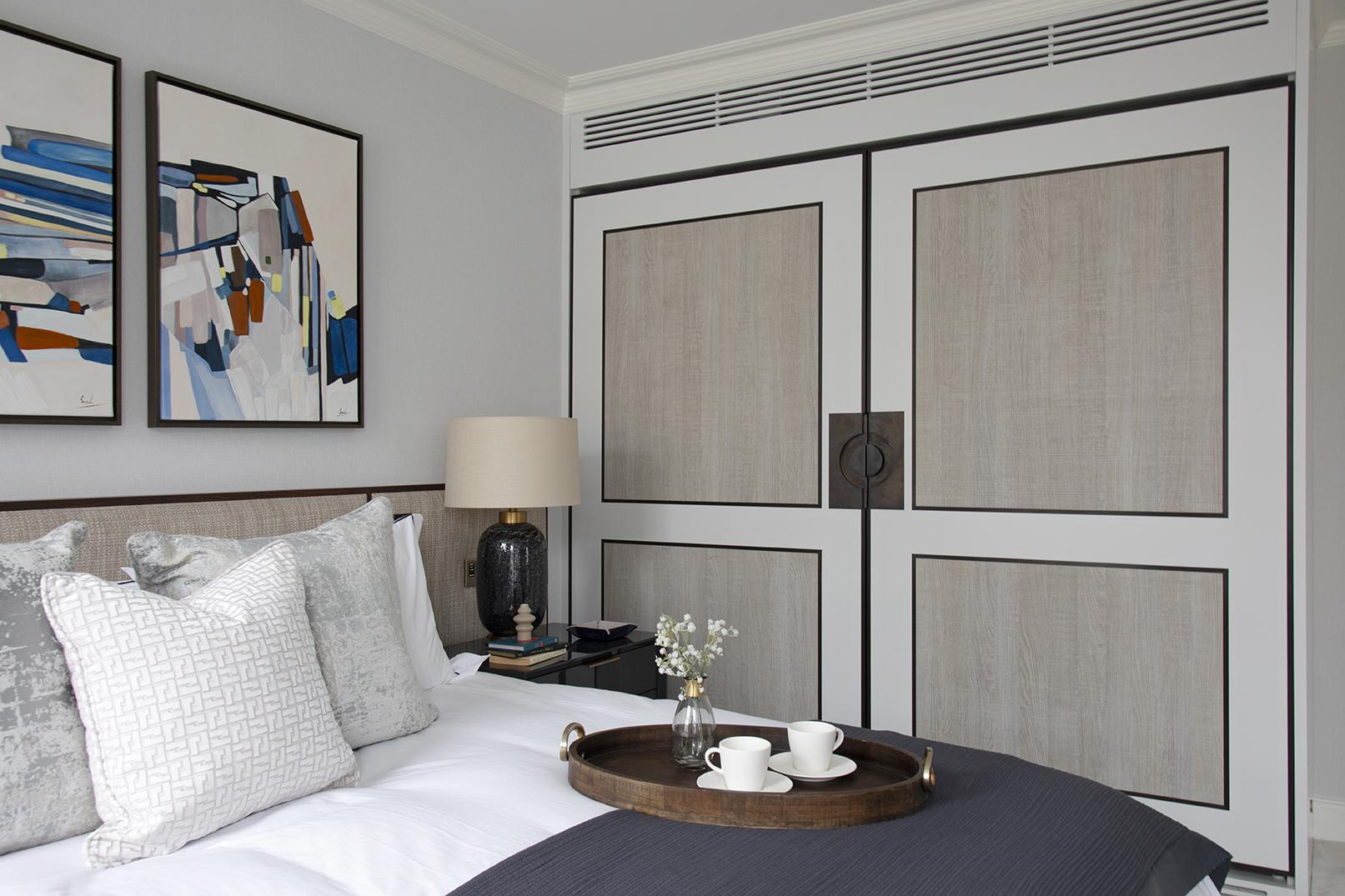
The most convincing radiator covers are the ones you do not notice, because they continue the room’s existing lines. If the wall has panelling, the cover’s rails and stiles are set out to align with the panel grid and sprayed the same colour, so the radiator reads as another panel bay. If the chimney breast has alcove cupboards either side, the covers under the windows are built with the same frame widths, shadow gaps and finish, so the whole room feels designed in one pass.
This is where a radiator cover stops being an accessory and becomes part of the joinery scheme. In practice we often build the cover in the same batch as the room’s alcove units, spraying every component together so the colour match is exact rather than close: one drawing, one colour, one dedicated team, one install. If you are costing the alcoves first, our alcove cupboards and shelving guide covers those figures in detail.
Do Radiator Covers Block Heat?
A well-designed cover makes little noticeable difference to a room’s warmth; a badly designed one genuinely can. Radiators heat a room mostly by convection: cool air enters at the bottom, warms against the panel and leaves at the top. A cover only causes problems when it interrupts that loop with a solid top, a closed base or too little open front area.
The fix is design, not compromise. Every cover we build follows the same rules:
| Design detail | Guideline | Why it matters |
|---|---|---|
| Clearance above the radiator | At least 50 mm | Lets warm air rise and escape freely |
| Side and front clearance | 25-50 mm | Prevents heat building up inside the box |
| Open front area | Generous slats, grille or mesh | The more open area, the freer the convection |
| Open base | Raised on legs or vented plinth | Draws cool air in to keep the cycle moving |
| Valve access | Removable front or access hatch | Thermostatic valves stay reachable for control and servicing |
| Reflective backing | Foil reflector panel behind radiator | Pushes heat into the room instead of the wall |
One more point worth knowing: thermostatic valves read the air temperature around them, so a valve sealed inside a warm box can switch the radiator off early. That, not the timber, is why cheap covers make rooms feel cooler. Keeping the valve ventilated and accessible solves it.
Are Radiator Covers Safe for Children?
This is one of the strongest practical arguments for a cover. Radiators can run hot enough to burn small hands, and their edges and valves sit at exactly toddler height. A fitted cover puts a cool-touch timber surface between child and panel, rounds off the hard corners, and is fixed back to the wall so it cannot be pulled over. For nurseries and playrooms we specify wider slat spacing at the top, where warm air exits, and tighter spacing lower down where fingers explore. It removes the most common contact risks in family rooms and hallways.
Which Materials Are Best for a Radiator Cover?
A radiator cover lives next to a heat source that switches on and off all winter, so material choice matters more than it does for most furniture. Moisture-resistant MDF is the standard for sprayed covers: it stays dimensionally stable through heating cycles, machines cleanly for fluted and slatted profiles, and takes a spray finish beautifully. Where budget allows, we build carcasses and bench seats from premium carcass materials, such as birch plywood, which adds stiffness for seating, while solid oak and other hardwoods suit tops and seat edges that take daily wear.
Grille inserts open up further choices: painted slats for a modern look, woven cane for warmth, or brass and steel mesh for a more tailored finish. Whatever the mix, a workshop spray finish is worth insisting on near a heat source, since brush-painted covers tend to soften and mark on the warm top surface. You can read more about how we select and finish timber on our materials page.
How Much Does a Radiator Cover Cost in the UK (2026)?
Radiator cover prices split into three clear tiers; the jump between them is about fit, materials and finish.
| Option | Typical price | What you get |
|---|---|---|
| Flat-pack retail cover | £40-£150 | Standard sizes, self-assembly, usually white; gaps at walls and skirting are common |
| Online made-to-measure | £150-£350 | Cut to your measurements, limited styles and colours, delivered for self-fitting |
| Bespoke fitted cover | From £350 (excl VAT) | Designed for the room, sprayed any colour, built in our own London workshop and fitted |
Within the bespoke tier, size and function drive the price. For specification detail and lead times, see our radiator covers service page.
| Bespoke radiator cover type | Typical price (excl VAT) |
|---|---|
| Standard single cover | £350-£900 |
| Cover with integrated storage or bench seat | £600-£1,500 |
| Full wall run with shelving or panelling | Quoted after survey |
Prices are a guide and exclude VAT. Every project is quoted individually after a free design consultation, and drawers and doors run on high-quality soft-close hardware as standard. If you are weighing one cover against a wider fitted scheme, it is usually cheaper per piece to commission them together, since design, spraying and installation are shared across the job.
Frequently Asked Questions
Do radiator covers block heat?
A well-designed cover has minimal effect on room warmth. Heat loss only becomes noticeable when airflow is blocked, so look for at least 50 mm clearance above the radiator, 25-50 mm at the sides and front, a generous open grille area and an open base. A reflective panel behind the radiator helps push heat back into the room.
How much does a radiator cover cost in the UK in 2026?
Flat-pack retail covers cost £40-£150 and online made-to-measure covers £150-£350. Bespoke fitted covers start from £350 excluding VAT, with most covers falling between £350 and £900. Adding integrated storage or a bench seat takes the range to £600-£1,500, and full wall runs with shelving or panelling are quoted after a survey.
Are black radiator covers a good idea?
Yes. Black and dark slatted covers are among the most popular 2026 designs, turning the radiator into a deliberate feature rather than something to hide. Colour has no meaningful effect on heat output, since airflow is what matters. Choose a wipeable sprayed finish, as matt dark surfaces show dust more readily than mid-tone colours.
Can a radiator cover have drawers or storage?
Yes, as long as the storage sits beside the radiator rather than directly over it, keeping the heat path clear. Typical designs pair the cover with flanking shoe cupboards, slim drawers or a bench seat, built as one piece. A bespoke cover with drawers or storage typically costs £600-£1,500 excluding VAT.
What is the best material for a radiator cover?
Moisture-resistant MDF is the best all-rounder for sprayed covers because it stays stable through heating cycles and machines cleanly for slatted and fluted profiles. Premium carcass materials, such as birch plywood, add strength for bench seats, while hardwood suits tops and edges. A workshop spray finish resists marking on the warm top surface.
Are radiator covers safe for children?
Yes, a fitted cover is one of the simplest child-safety upgrades in a family home. It places a cool-touch timber surface between small hands and the hot panel, rounds off hard corners and valve edges, and is fixed to the wall so it cannot tip. Ask for wider slat spacing high up and tighter spacing at child height.
Design Your Radiator Cover with Noba & Stod
The right radiator cover is designed for its wall, not picked from a size chart. Noba & Stod design, build and fit bespoke radiator covers across London, from a single hallway bench to full panelled runs, all built in our own London workshop, sprayed to any colour and installed by one dedicated team. Read more about how we work.
Book a free design consultation and we will measure the space, sketch options and give you a fixed quotation. Get in touch through our contact page or call us on 0207 118 9889.