An in-frame kitchen is a kitchen where each cabinet door sits within, and is surrounded by, a visible face frame fitted to the front of the carcase, so a narrow strip of frame shows around all four edges of every door and drawer, unlike a frameless or full-overlay kitchen, where the doors cover the carcase edge to edge.
In-frame is the traditional English cabinetmaking method, and it’s the construction Noba and Stod builds most often for period properties and for clients who want their kitchen to read as furniture rather than as fitted units. Because the frame is structural as well as visual, an in-frame kitchen tends to feel heavier and more substantial than a frameless equivalent, and it ages well: small, natural movement in a door over time is far less noticeable against a surrounding frame than on an edge-to-edge frameless front.
We build the frame from solid timber, joined at the corners, with the door set back very slightly from the face of the frame so each one opens and closes cleanly without rubbing. It’s a more involved build than a frameless kitchen, with more joints and more hand-fitting on site, which is one reason in-frame kitchens are usually positioned toward the higher end of a kitchen project.
In an in-frame kitchen, every door and drawer front sits inside a face frame fixed to the carcase, leaving a visible strip of frame around each door, an approach rooted in traditional English cabinetmaking. This differs from a frameless (full-overlay) kitchen, where doors cover the carcase edge to edge with no frame showing, and it differs from Shaker style, which describes the design of the door itself rather than how it’s fitted to the carcase, meaning a kitchen can in fact be both in-frame and Shaker-style at the same time.
In-Frame vs Frameless (Full-Overlay)
The difference between the two comes down to what happens at the edge of the carcase, not to the style of the door itself.
| In-Frame | Frameless / Full-Overlay | |
|---|---|---|
| Carcase front | Fitted with a visible timber face frame | No frame; the carcase edge is hidden behind the door |
| Door position | Sits inside the frame opening, set slightly back | Sits flush over the carcase front, edge to edge |
| Visual style | Traditional, furniture-like, more visible joinery | Clean, contemporary, minimal visible framework |
| Build approach | More joints, more hand-fitting on site | More standardised carcase construction |
| Best suited to | Period properties, bespoke and heritage-style projects | Contemporary and open-plan kitchens |
In-Frame vs Shaker Style: What’s the Difference?
This is one of the most common points of confusion, because the two terms describe different things. In-frame describes how the door is fitted to the carcase, inside a surrounding timber frame rather than flush over it. Shaker style describes the design of the door panel itself, a flat, recessed centre panel with no applied moulding. A kitchen can be Shaker-style and frameless, Shaker-style and in-frame, or built in either construction with a different door design entirely. In practice, a lot of what people picture when they search for a Shaker kitchen is actually an in-frame Shaker kitchen, which is why the two get bundled together, even though only one of them describes the frame.
In-Frame in Practice
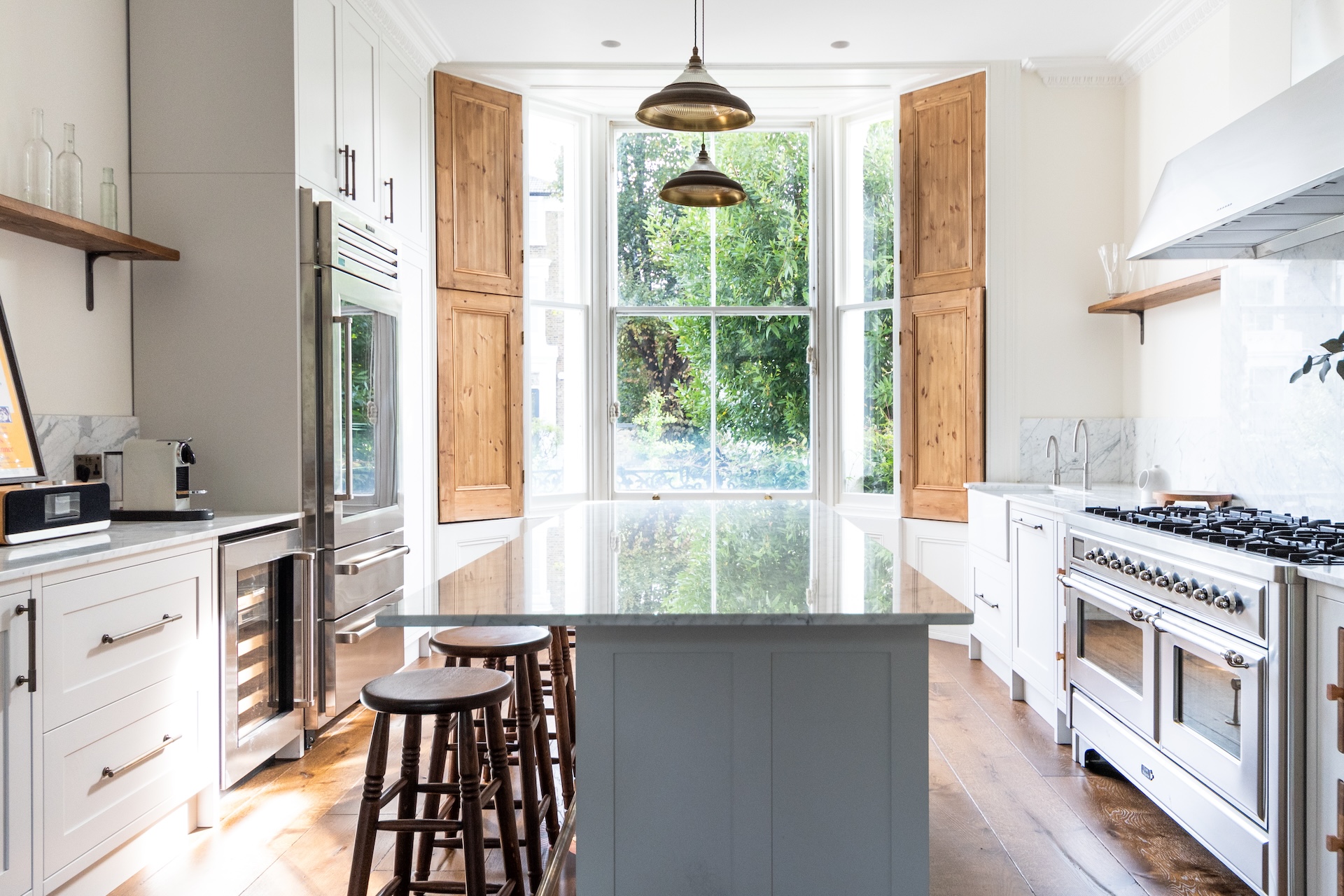
A painted in-frame kitchen with a timber island, showing the visible surrounding frame around each door and drawer front that defines the in-frame construction.
Related Terms
See Shaker Style for the door design most often paired with in-frame construction, Handleless Kitchen for a frameless-friendly alternative, and Kitchen Carcase for what the frame is fixed to.
Frequently Asked Questions
Can a kitchen be both in-frame and Shaker style?
Yes. In-frame describes the carcase construction and Shaker describes the door design, so the two are often combined in the same kitchen.
Is an in-frame kitchen more expensive than a frameless kitchen?
Generally, yes, because of the extra timber, joinery and hand-fitting involved, though the exact difference depends on the specification. Speak to us directly for guidance on your project.
Planning a project that involves this? See our bespoke kitchens service, or get in touch to talk it through.